Most people throw out furniture worth saving because someone told them reupholstery costs more than buying new, and a site that explains frames, yardage and fabric turns that doubt into a booked estimate.
Fill out your information and in 3 simple steps your preview will be built, no coding necessary.
The beginning of your home on the web starts with a name.
Tell us a bit about your business; the services you offer, and your history.
Let us know how customers can best contact or reach you.
Watch this short video for a quick walk through on how simple it is to get your website online.
Website Design made easy. Just one click away.
Get StartedFast, Friendly, Secure, Quality
All of our websites are fully secured with SSL encryption as well as top of the line servers.
Our web hosting servers have an uptime of 99.99%. Host with us hassle free with an online gurantee.
Half the people who should be calling you have already decided reupholstery costs more than buying new. On a stapled softwood frame with sinuous springs, they are often right. On a kiln-dried hardwood frame with eight-way hand-tied springs, they are flatly wrong, and that sofa goes to the curb instead of to your shop. Without a site, you never get to draw the line for them.
A customer with a camelback sofa wants to know how many yards it takes, whether the stripe has to line up, and whether she can buy fabric somewhere else and bring it in. That is twenty minutes on the phone, over and over, for people who have not decided anything yet. Written once on a page, it does the same work while you are pulling staples.
A rebuilt wingback does not sit in a showroom window. It gets delivered to a living room and seen by whoever happens to visit. The stripped frame, the new jute webbing, the finished piece shot in good light — that is the only showroom a shop like yours has, and it has nowhere to live without a website.
Someone is giving you a piece they cannot replace, often one they inherited, and living without it for weeks. Before they load it up they want to see the shop, the work, and other people who got their furniture back better than it left. A social page with a dozen photos from four years ago does not settle that.
Nobody keeps an upholsterer in their contacts. The search starts on a phone, usually standing next to the piece, and it is specific: reupholster dining room chairs, sofa cushion foam replacement, boat seat repair, antique chair restoration. What they are scanning for first is whether you handle their kind of job at all, because a shop that rebuilds restaurant banquettes and a shop that reties springs in a 1910 settee are not the same shop, and the phone book does not say which is which.
Then they look for pieces like theirs. A six-chair dining set is the job most people start with — it is the cheapest way to find out whether they trust you — and a sectional or a full living room set is what they come back for. They want to see the before, the frame mid-teardown, and the after. They want to know whether you keep fabric books in the shop or expect them to show up with a decision already made, and whether you take customer's own material and under what conditions.
The timing is rarely urgent, which changes everything. Boat owners want cushions done before launch, not in July. Restaurant owners want booths recovered on a shutdown week in the slow season, measured months ahead. A family dealing with an estate has a houseful of furniture and no idea what any of it is worth saving. All of those people are researching early and comparing two or three shops carefully, which means the shop that explains the most usually gets the call.
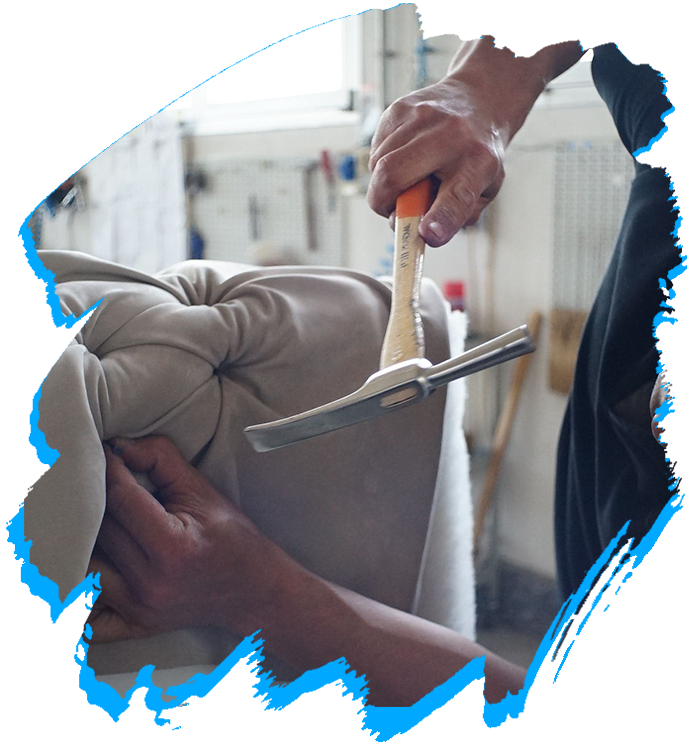
Dining chairs, sofas and sectionals, antiques, marine, auto, commercial. Someone with four kitchen chairs should find four kitchen chairs in two taps, not scroll past a yacht interior to get there.
A short page that says what makes a piece worth reupholstering: kiln-dried hardwood, mortise-and-tenon joints, eight-way hand-tied springs. And what usually does not: staples, softwood, a frame already cracked at the rail. Saying so when it costs you a job is the fastest trust you will ever build.
That you measure the piece, count yards, and that a pattern repeat or a stripe that has to match adds yardage. That teardown sometimes reveals broken springs or rotted webbing. People are not afraid of a number, they are afraid of a number that changes with no explanation.
Whether customers choose from books in your shop, how samples work, and exactly what you need if they supply their own material — yardage confirmed before purchase, railroaded or not, delivered to the shop before the piece goes on the bench.
Double rubs explained in one sentence, what a house with two dogs needs, and the real difference between top-grain leather, vinyl and a performance weave. This is the page that stops a customer picking a pretty silk for a family room sofa.
Marine and auto are separate trades with separate materials — UV-stable thread, closed-cell foam, marine-grade vinyl, correct auto patterns and listings. Commercial booth and banquette work needs its own page too, with fire-code fabric and the fact that you can work a shutdown schedule.
A realistic multi-week window, where you are in the queue, and the promise of progress photos. Someone who has given up their sofa for five weeks will call you twice if the site has not already told them what happens and when.
Most of what you work on does not fit in a car. Say whether you pick up, what you charge for it, how far you go, and what to measure if a stairwell is involved. That one paragraph removes the biggest reason an inquiry stalls.
Stripped to the frame, rebuilt, and recovered in fabric you choose. A sound frame comes back better than the day it was bought, with springs and padding replaced along the way.
Seats, backs or full frames for a set of four, six or eight. The usual starting job, and the one that tells you whether a shop is worth handing a sofa to.
Multi-piece work done as one job so every panel comes from the same fabric run. Bigger pieces mean more yardage and a longer bench time, planned out before anything is torn down.
Pieces with history, handled with the methods they were built with — horsehair, cotton batting, jute webbing and hand-tied springs where that is what the piece calls for.
Regluing loose joints, replacing broken rails, retying springs that have gone slack. The structural work nobody sees, which is the part that decides how long the new fabric lasts.
New foam, new wrap and new zippers in your existing covers, when the frame and fabric are fine and only the sitting has gone flat. Far less than a full reupholstery.
Hides and commercial vinyl sewn for seating that gets daily use. Leather wears differently than fabric and costs differently, and both get explained before anything is ordered.
Boat seating, bolsters and cockpit cushions in marine-grade vinyl with closed-cell foam and UV-stable thread, built for standing water and full sun.
Bench and bucket seats, door panels, headliners and convertible tops. Restoration work matched to the correct pattern for the year and model wherever the customer wants it original.
Restaurant seating recovered in fire-code-rated material, scheduled around a closure so the dining room opens on time. Bar stools and waiting-room chairs on the same visit.
Smaller pieces, custom built or recovered — tufted headboards, window seats, storage benches, bar stool tops. Often the piece that turns into a whole-room project.
Replacement cushions and slings in solution-dyed performance fabric that holds its color through a full season of sun instead of fading by August.
| BuilderNow | DIY website builders | |
|---|---|---|
| Who builds it | We build the whole site from what you tell us about your shop. | You build it yourself, in your own time, after the shop closes. |
| Price | $25 a month or $250 a year, domain and hosting included. | A plan fee, then the domain, then add-ons, billed separately. |
| Adding a finished job to the gallery | Email us the before and after photos and we add them for you. | You log in, upload, crop and lay the page out yourself. |
| Technical skill needed | None. If you can describe the work, you can get the site. | Enough to handle templates, image sizes and layout settings. |
| Support | Included. You ask a person for a change and it gets made. | Help articles and forums, most of it self-serve. |
| Trying it first | 30 days free on a yoursite.buildernow.net address. | Trials vary, and the work of building it is yours either way. |
52% of consumers start a local business search on Google Search.
BrightLocal, 202645% of consumers say businesses without websites feel less real.
DreamHost, 202674% of consumers care about reviews written in the last three months.
BrightLocal, 202617% of small businesses still have no website.
Clutch, 2025Every week, somebody within driving distance of your shop puts a hardwood-framed sofa on the curb because nobody told them it was worth saving. A site that explains frames, fabric and yardage is how you reach that person before the trash truck does.
The 30-day trial costs nothing and we do the building. Tell us what your shop takes on — dining sets, antiques, boat cushions, booths — and read the site on your phone before you decide whether to keep it.
Start the free trial